
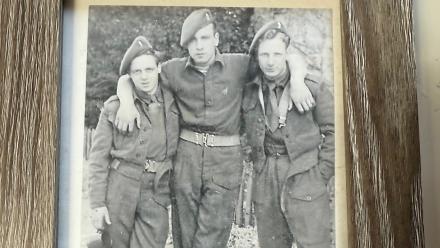
A chance meeting between a 19-year-old American history enthusiast and a 96-year-old former serviceman led to a very special conversation at Lake House in Adderbury – one that captured memories of wartime Britain and a remarkable life shaped by history.
In the summer of 2025, Luis Rodriguez travelled from America to England with a passion for Second World War history. Keen to hear first-hand accounts from people who had lived through the conflict, he contacted The Orders of St John Care Trust (OSJCT) to ask whether any residents might be willing to share their experiences.
Lake House was delighted to help, and it soon became clear that resident John Loveridge had a story worth hearing.
At 96, John had lived through the war as a child and gone on to complete National Service in the years that followed. Luis visited Lake House to interview him, with John's brother-in-law and OSJCT Regional Marketing Manager, Helen Dearing, also joining the conversation.
What followed was an opportunity for John to look back on his childhood, his time in the Army and the experiences that had stayed with him throughout his life.
Growing up during the war
John was just 10 years old when the Second World War broke out in 1939. Growing up in a village near Banbury, he remembered a childhood very different from the one many young people experience today.
He spoke openly about the hardships his family faced, describing wartime life as “terrible”. There were six people in the family, and rationing meant food was in short supply. John recalled receiving just two ounces each of bacon, sugar and butter.
His father earned five shillings a week, and the family could not afford a radio. John sometimes heard Winston Churchill's speeches when he went to the cinema.
From the age of 14, John worked as a driver's mate for United Dairies, travelling to farms to collect milk and bring it into Banbury. The farmers would sometimes give him food to take home, including bacon and potatoes, and he was also given a small churn of milk each day.
John also remembered the bombing of Banbury. He recalled the gas works, railway and canal being targeted one Thursday afternoon, although, thankfully, he did not remember anyone being killed. He spoke about the efforts made to protect local industry, including Alcan building a dummy factory to divert enemy bombers away from the real one. He could also remember seeing the sky turn yellow and red during the bombing of Coventry. Looking back, he felt that Banbury and Oxford had been fortunate compared with other places.
National Service and an experience he never forgot
John was 16 and a half when the war ended. He remembered the celebrations that followed, with street parties, jam tarts and fireworks bringing people together to mark the occasion.
His own military service came soon afterwards. Called up in April 1946, aged 17, John spent two and a half years completing National Service with the Royal Artillery. He described the tough training, which included marching, rifle practice, assault courses and long-distance marches carrying a full pack. He was initially posted to Italy before moving on to Germany.
One experience in particular remained with him. Around two years after the war, John visited Bergen-Belsen, where he saw former prisoners still walking around in their striped clothing.
It was a powerful memory and a reminder of the human impact of the conflict. John spoke about the visit during his conversation with Luis, sharing an experience that had stayed with him for the rest of his life.
There were lighter moments in his Army stories, too. John recalled taking part in an Army tug-of-war competition in Berlin, where his team of 12 reached the final and went on to win a gold medal. He remembered being daunted by the size of the opposing team, until his sergeant reassured him that they were padded. His team went on to win.
A life built around family
After leaving the Army, John returned to civilian life and worked in a number of jobs, including in cold stores stacking meat, before moving into other manual work and eventually working in a concrete mould shop making garages.
But perhaps the most important part of John's life was his family. He adored his wife, June, and they shared a very happy marriage. Together they had three children, Carol, Robert and Sharon, and went on to build a family that grew to include six grandchildren and 13 great-grandchildren.
John spoke with enormous pride about his family. When asked what had helped him through life's challenges, his answer was simple: his family.
And when Luis asked what advice he would give to younger generations, John offered two short but memorable responses: “Behave yourself” and “Don't go to war.”
His answers reflected the straightforward, good-humoured character that came across throughout the interview, as well as the importance he placed on family and the life he had built with June.
A special experience for Luis
For Luis, the visit was significant for another reason. It was his first time interviewing a veteran from outside America. He said:
“This was my first time interviewing a non-American veteran, which made it a very special occasion for me. I couldn’t have been happier to listen to Mr John’s incredible story. I also really enjoyed speaking with the other residents and staff. They were all very kind and happy to speak with me.”
Luis runs a YouTube channel, Military History Unveiled, where he shares his interest in military history and the stories behind it.
Keeping John's story alive
Alex Grindle, Home Manager at Lake House, said:
“It was a real privilege for Lake House to be part of this special opportunity. John had so many memories and stories to share, and it was lovely to see him given the time and space to talk about his experiences. These conversations are incredibly important, not only for the people sharing their stories, but for younger generations who may not otherwise have the chance to hear them first-hand. We feel very fortunate to have been able to help bring John and Luis together.”
Sadly, John passed away before he had the opportunity to hear the edited conversation or see the finished video. With the permission of his family, we are sharing his story during the Remembrance period, so that his memories and experiences can continue to be heard.
The opportunity to sit with someone who lived through such a significant period in history is a privilege. John's recollections offered Luis a personal perspective on events he had spent so much time studying, while giving everyone involved a chance to hear, first-hand, what life was really like for one young boy growing up during the war.
We are grateful to John and his family for sharing his story, and to Luis for taking the time to listen and help preserve these memories for future generations.
Watch the YouTube interview: https://youtu.be/8RRjF0krcBk
Lest we forget.