

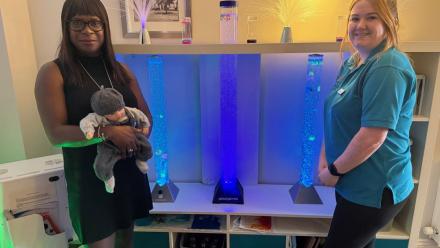
A family perspective from Larkrise Care Centre
Rachel John’s mother has lived at Larkrise Care Centre for two years. What began as respite care quickly became something more.
“It Felt Like Family”
“I loved it straight away,” Rachel says. “The carers treat her like family. When I walk in, it doesn’t feel like obligation — it feels like I’m coming somewhere we belong.”
When her mum’s dementia progressed and she could no longer stay safe at home, that sense of familiarity made a difficult decision easier. “She came somewhere she already knew — and that meant everything.”
Why sensory care matters
Rachel believes sensory support is essential, not optional.
“With dementia, it’s like the brain never switches off. Small things can feel overwhelming or frightening.”
For her mum, sensory tools reduce anxiety and bring calm. “They help her feel safe.”
Connection without words
Following a stroke, Rachel’s mum is non-verbal. Sensory care has become their way of communicating.
“It’s how we connect now — through touch, sound, light. It replaces words.”
Music, textures and movement spark engagement. “You can see something reach her, even if she can’t say it.”
Familiarity brings comfort
One item in particular — a knitted fiddle muff — has been transformative.
“Mum knitted all her life. When she uses it, it’s like she’s doing that again. She’s calmer. I think it brings her back to something familiar.”
Rachel believes these moments tap into long-term memory. “You don’t always know what’s being triggered — but you can see the change.”
Meeting people where they are
Rachel was encouraged by an Admiral Nurse to think of dementia as a series of “shelves” — different stages of life her mum moves between.
“You have to work out which shelf your loved one is on. They might be 20 again, or in their 30s, or their 60s.”
“Some days she’s in her 20s, remembering her dad. Other days it’s different. That’s why variety matters — something will reach her, wherever she is.”
A space for connection
The sensory room offers more than stimulation — it offers togetherness.
“It’s a place where you can just sit and be. Where connection doesn’t rely on words. That’s priceless.”
For Rachel, that’s the real impact: not just comfort for her mum, but a way to stay close — even as things change.
The sensory room reflects Larkrise’s commitment, as part of The Orders of St John Care Trust (OSJCT), to supporting people to live well with dementia. By creating an environment that soothes, stimulates and reassures, sensory care helps reduce anxiety, spark recognition and enable connection — even when words are no longer possible. It is through these moments of calm, familiarity and engagement that dignity is preserved, and meaningful relationships continue.